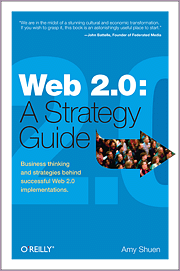
Web 2.0: A Strategy Guide by Amy Shuen (O’Reilly Media)
Like everyone competing in business today, I am buried in unhelpful technology trend books. But I had not made it out of Shuen’s Preface before realizing. . .
Web 2.0: A Strategy Guide by Amy Shuen (O’Reilly Media)
Like everyone competing in business today, I am buried in unhelpful technology trend books. But I had not made it out of Shuen’s Preface before realizing. . .
I have just finished reading Clive Thomspson’s WIRED artcile on the Future of Reading. The notion of unleashing the book online to prod readers into interacting with text sounds like fun and I like the idea of focusing on the reader. I look forward to all the variations and trials that publishers put forward in the coming months, but there is one aspect of books that I hope they maintain in all their experimentation…
I saw this via @weknowbooksetc Twitter feed… and it made me laugh.

I warn you though, you must be able to handle REALLY bad puns to click through this year’s offerings at this year’s Edible Book Contest hosted by the Duke Univeristy Library System. You have been warned… Ha!
O’Reilly Media’s Programming Scala won’t hit bookstore shelves for a long time. But the entire working manuscript has been posted to their site! Each and every paragraph, sidenote, chart and graph has a comment box underneath it. They are hoping that the community will contribute knowledgeble bits of information and ideas, which the author will vet and toss or incorporate. The idea is that this crowdsourcing filtered through their expert author will produce a more auhtoritative work.
Not too mention the marketing side of things. I guess one side could say “you’ll sell fewer books, because all of your hardcore readers have been reading while it’s been written”. Which might hold true for a few folks. But can you imagine the buzz this would build within the programming community? Or how much of a boost the book might get from folks talking about/buying a book that they were involved in producing? The system has a sign-in for commenters so that they can be credited in the final book, if their contribution is used. O’Reilly also provides RSS feeds for the various sections so that a commenter can keep up with that specific section of the text.
Obviously, this idea wouldn’t work for every type of book and the progamming community is a good place to start. It’s not the first book to be published from crwodsourced information, but it’s the first time, I’m aware of, a major publisher has added a crowdsourced component to the traditional publishing workflow. Which means that it gets checked and balanced by author and editor, which may be enough to sway a few naysayers.
I wonder what Andrew Keen would think of this community/professional mashup? Ha!